Your own water, quoted up front.
We survey the ground, drill and case the hole, test what it really yields, then size the pump to match.

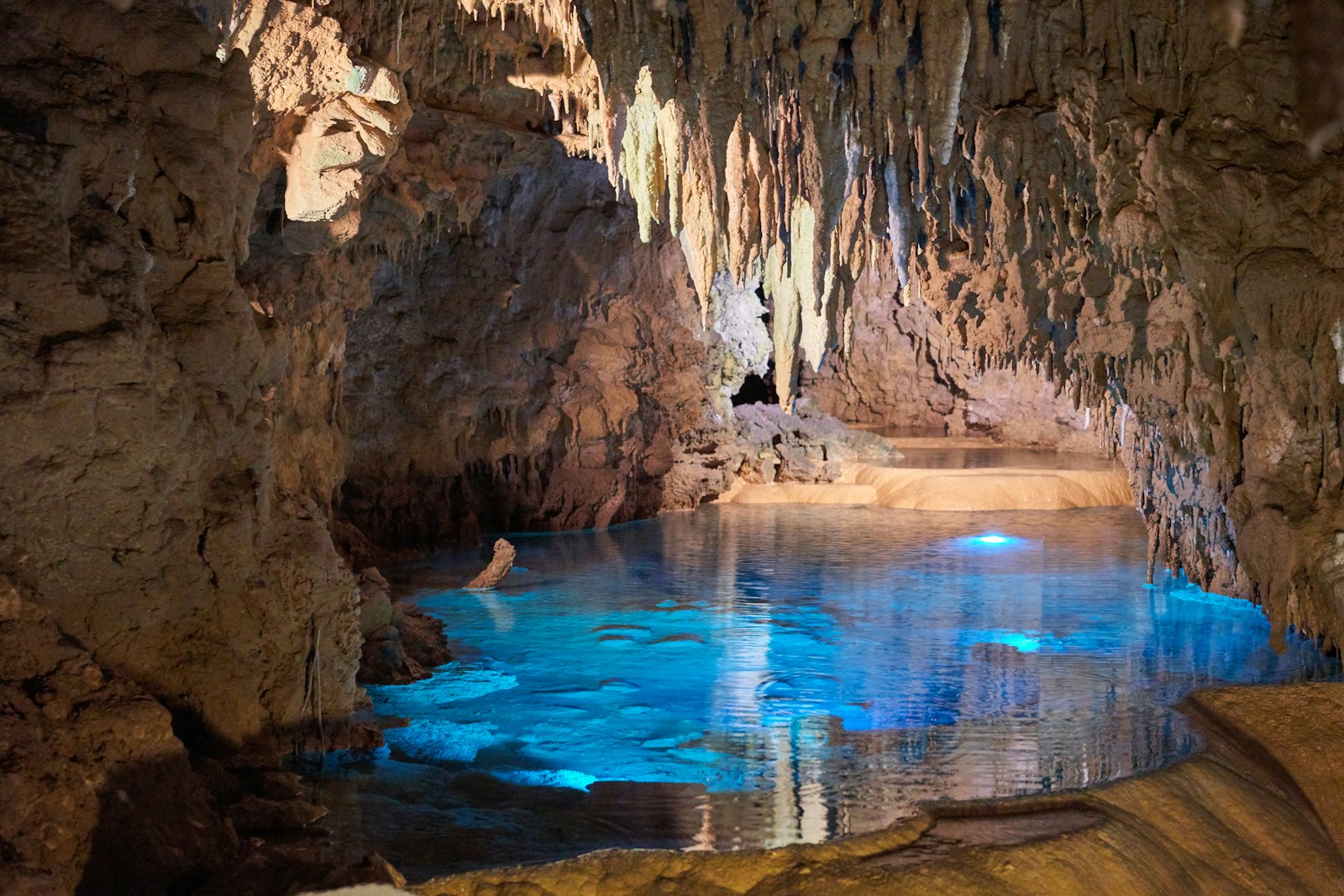
Gauteng is standing on a cave system.
Much of the West Rand, Krugersdorp and Pretoria sits on Chuniespoort Group dolomite. Dolomite dissolves in slightly acidic groundwater, so over millions of years its joints and fractures widen into conduits and, in places, into caves. The Cradle of Humankind caves are the same rock. Your borehole is a hole into that.
The yield can be exceptional
Karst dolomite compartments sustain some of the highest yielding boreholes in the province, and they are the main water resource for many towns and farms on the West Rand.
The ground can be unstable
Sinkholes and subsidence happen on dolomitic land. This is why the site walk is not a formality, and why we will not drill a dolomite site blind.
The water needs more testing, not less
Karst filters poorly. Surface water can reach the aquifer through swallow holes without passing slowly through soil first, so a SANS 241 analysis on dolomite is not optional.

The same water grows the crystals
Amethyst and quartz form when mineral rich groundwater stands in a rock cavity long enough to precipitate out. The water in your borehole has been doing that same chemistry on its way to you. What is dissolved in it depends entirely on the rock it came through, which is the whole reason we send a sample to a laboratory instead of guessing.
The whole job, from survey to running tap.
One team for every stage, so nobody can blame the last contractor for what went wrong.
Borehole siting
A geophysical survey using electromagnetic induction and electrical resistivity to map the fracture zones under your property, so the rig drills a target instead of a guess. You keep the hydrogeologist's report whether or not you drill with us.
Drilling and casing
Rotary percussion with a down-the-hole hammer. Steel casing through the soft ground into bedrock, slotted PVC and a gravel pack below it.
Development
Airlifting and flushing until the water runs clear. Skipping this stage is why some boreholes silt up inside a year.
Yield testing
Step-drawdown, constant discharge for 6 to 72 hours, then recovery. You get a yield certificate in litres per hour, which is the document your bank asks for.
Pumps and equipping
A submersible pump sized on total dynamic head against your tested yield, with dry-run protection, riser main, tank and controls.
Water quality
Laboratory analysis against SANS 241, the South African drinking water standard. Filtration or UV only where the results call for it.
Eight stages, priced before each one.
This is the order a borehole is supposed to follow. Where a driller skips a stage, and it is usually development or the yield test, you find out two summers later.
Site walk
We check rig access, gate widths, overhead lines and buried services, and confirm what your municipality requires before anyone drills.
Siting survey
Electromagnetic and resistivity traverses across the property, then a written report with a marked drill point and an expected depth range.
Itemised quote
Rate per metre, site establishment, casing per metre, testing and pump, each priced separately with a ceiling agreed in writing.
Drilling
The rig drills to solid rock, steel casing goes in, then drilling continues into the water bearing fractures. One to two days on site.
Casing and gravel pack
Slotted PVC and a silica gravel pack where the formation is sandy. The hole is capped the same day so nothing falls into it.
Development
Airlift and flush until the discharge runs clear, so the fractures are open and the borehole gives what it is actually capable of.
Yield test
Step-drawdown, then constant discharge and recovery monitoring, to establish the sustainable yield in litres per hour.
Equip and hand over
Pump, tank and controls commissioned, then your handover pack: driller's log, yield certificate and water analysis.
Our rates, published.
Almost every borehole company in South Africa answers "what does it cost?" with "it depends". It does depend on depth and on rock. The rates do not.
| Item | Rate | What it covers |
|---|---|---|
| Before the rig moves | ||
| Siting survey | R5 000 to R8 000 | Geophysical traverses, marked drill point, written report. Credited against the drilling if you go ahead. |
| Site establishment | R7 000 | Once off. Moving the rig, support truck and crew onto your property and setting up. |
| In the ground | ||
| Drilling | R500 to R1 200 / m | Per metre drilled. The East Rand sits at the lower end, the granite belt north of Johannesburg at the upper. |
| Steel casing | R600 to R700 / m | Through the soft ground into bedrock. Only the metres actually cased. |
| Slotted PVC and gravel pack | R400 to R550 / m | Where the water bearing formation is sandy and needs screening. |
| Development | R2 000 to R5 000 | Airlifting and flushing until clear. Not optional, and not an extra we spring on you. |
| Proving it and equipping it | ||
| Yield test | R2 500 to R5 000 | Step-drawdown, constant discharge, recovery, and the yield certificate. |
| SANS 241 water analysis | R1 500 to R3 000 | Accredited laboratory, full potability report. |
| Pump, tank and commissioning | from R25 000 | Submersible pump, riser main, cable, control box, dry-run protection and a 5 000 litre tank. |
| Typical complete domestic borehole | R65 000 to R120 000 | Sited, drilled to 60 to 100 m, cased, developed, tested and equipped. |
Ranges reflect published 2026 South African borehole pricing and vary by province and geology. Limpopo and the Eastern Cape run higher, the Northern Cape lower. A dry hole is charged at the per-metre drilling rate only: you do not pay for a pump, permanent casing or equipping on a hole that does not deliver. Last updated August 2026.
The paperwork, not just the hole.
The Borehole Water Association tells homeowners to demand these documents. Most people never receive them. They are part of every job we finish.
- 01
Driller's log
A metre by metre record of the formations drilled, the water strikes and their depths, and exactly how the hole was constructed.
- 02
Formation samples
Chip samples bagged from every metre drilled, so the log can be checked against the ground rather than taken on trust.
- 03
Yield certificate
Sustainable yield in litres per hour with the drawdown and recovery data behind it. This is the document banks ask for on a bond.
- 04
SANS 241 water analysis
An accredited laboratory report telling you whether the water is safe to drink as it stands, and what to treat if it is not.
- 05
Pump specification
Which pump was fitted, at what depth, and the total dynamic head calculation that justifies it. You will need this in eight years.
- 06
A written contract, up front
Scope, rates and an agreed maximum before the rig moves, on the Borehole Water Association standard form.
Photography on this page is stock imagery of comparable geology, not photographs of our own sites.
Work carried out to SANS 10299, the South African standard for the development, maintenance and management of groundwater resources.
How much water do you actually need?
Yield is measured in litres per hour, and more is not automatically better. An oversized pump on a modest borehole is the most common way people ruin a good hole.
A low yielding borehole is not a failed borehole. Pumped gently into a 5 000 litre tank across a full day, even 300 L/h supplies a household comfortably. The tank does the work the aquifer cannot do all at once.
Borehole questions, answered straight.
Published 2026 rates for Gauteng run about R500 to R1 500 per metre drilled, plus a once off site establishment fee of roughly R7 000, casing at R350 to R700 per metre and a pump system from about R15 000. A complete domestic borehole and pump system lands between roughly R65 000 and R120 000 depending on depth and geology. We quote a fixed, itemised price after the siting survey, and our rates are published on this page.
Most South African domestic boreholes are between 40 m and 120 m deep. Some sites strike good water at 30 m, while hard granite and quartzite formations in northern Johannesburg can need 150 m or more. Only a geophysical siting survey can narrow it down before the rig arrives, which is why we never quote a depth blind.
The actual drilling is usually done in one to two days. From your first call to water at the tap is about four weeks for a domestic borehole, because the siting survey, the yield test and the pump installation each need their own visit.
For normal household use, no national registration is required. On 22 July 2026 the Department of Water and Sanitation confirmed in writing that households using borehole water for reasonable domestic purposes are exempt under Schedule 1 of the National Water Act, and cannot be penalised for not registering. Municipal by-laws are separate and still apply: Johannesburg and Ekurhuleni require written consent before drilling, and Cape Town requires an application 14 days beforehand plus registration afterwards. Commercial, agricultural and industrial abstraction must still be registered with the Catchment Management Agency. We handle the municipal paperwork for your area as part of the job.
You pay for the metres drilled, not for the pump, the permanent casing or the equipping. No honest driller in South Africa guarantees water, because the ground is the ground. What a proper geophysical survey does is cut the odds of a dry hole sharply, and we will tell you the realistic odds for your site before you commit a cent.
Often yes, but it has to be tested, because you cannot tell by looking. We send a sample to an accredited laboratory for analysis against SANS 241, the South African drinking water standard. Where the results call for it, iron and manganese removal, sediment filtration or UV sterilisation fixes it. Retest annually.
A yield test measures how many litres per hour your borehole can sustainably deliver, and it is what the pump is sized against. It runs in three parts: a step-drawdown test at increasing rates, a constant discharge test of 6 to 72 hours, and recovery measurements as the water level returns. You need one for two reasons. An oversized pump on an untested borehole burns out, and banks require a yield certificate before granting a bond on a property whose main water supply is a borehole.
A properly constructed borehole lasts 30 to 50 years and often longer. The parts wear at different rates: PVC casing 20 to 40 years, the submersible pump 8 to 15 years. Annual water level and water quality checks, plus a pump service every 3 to 5 years, are what get you to the top of that range.
About 6 m by 6 m of clear working space and a 3 m wide access route to reach it. A truck mounted rig weighs 15 tonnes or more, so we check access, overhead power lines, underground services and gate widths during the site walk, not on the morning the rig arrives.
A typical household needs 500 to 1 000 litres per hour, which covers indoor use and a normal garden. A smallholding with livestock or irrigation needs 2 000 to 5 000 litres per hour. Anything lower is not useless, because a low yielding borehole pumped slowly into a storage tank still supplies a house comfortably. The sizing table is above.
Let's find your water.
Tell us where the property is and what you need. We book the site walk, run the siting survey and come back with a fixed, itemised quote. The survey fee comes off the drilling if you go ahead.